
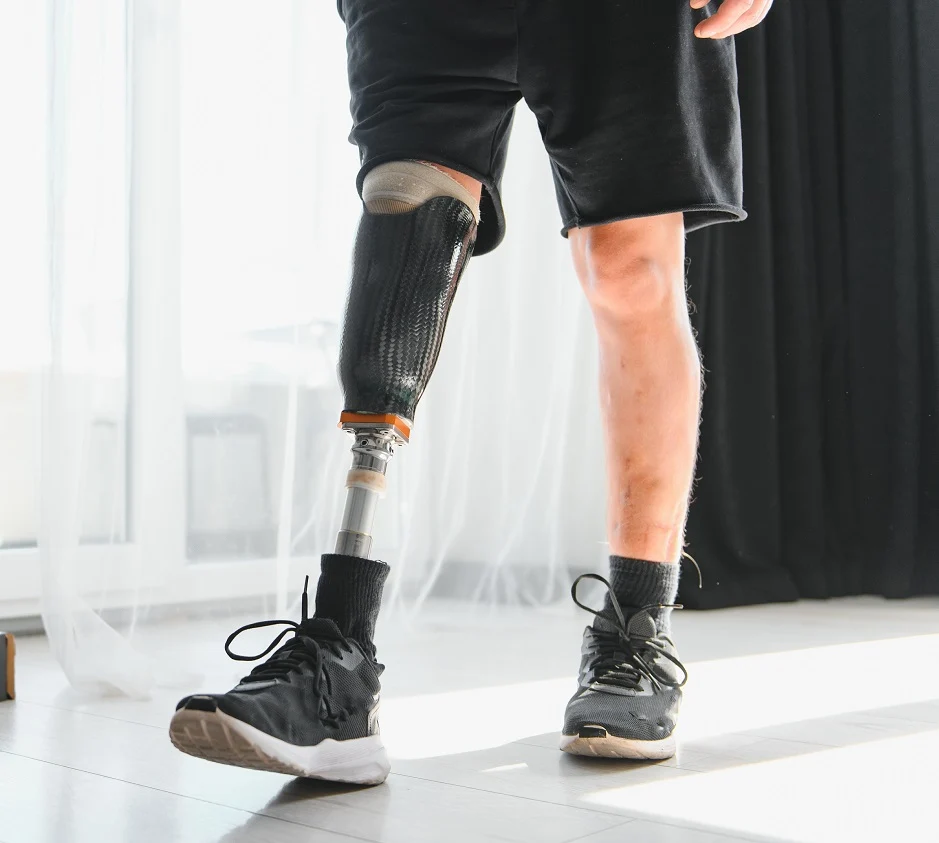
Osseointegration (Bone-Anchored Limb Prosthesis)
Rehabilitation
Starting from
$35,000
Up to $75,000 depending on centre
Typical duration
14–30 days
Including pre-operative work-up

Content reviewed for medical accuracy by: Dr. Rodina Ainasoa · Medical Content Writer & Health Communications
Overview
Osseointegration replaces a traditional socket prosthesis with a titanium implant surgically anchored directly into the residual limb bone, to which an external prosthetic limb is then attached via a percutaneous connector. This eliminates socket-related skin problems and improves proprioception and comfort for suitable candidates, but requires a surgical procedure — typically staged over two operations — and a structured rehabilitation programme abroad at internationally accredited orthopedic centres, at a fraction of Western pricing.
Your case is matched to a centre on the basis of clinical outcome data, not marketing. We coordinate every step — from pre-operative work-up to post-treatment follow-up — with a dedicated care coordinator.
What's included
Osseointegration (Bone-Anchored Limb Prosthesis)
Coordinated from
or message us on WhatsApp
No commitment required. Your data is never shared with third parties.
Osseointegration vs. Traditional Socket Prosthesis
Both approaches attach an artificial limb to a residual limb after amputation, but they do so in fundamentally different ways. Here is how a bone-anchored (osseointegrated) prosthesis compares with a traditional socket prosthesis.
| Parameter | Traditional Socket Prosthesis | Osseointegration (Bone-Anchored Prosthesis) |
|---|---|---|
| Attachment method | The residual limb sits inside a custom-moulded socket, held in place by suction, a liner, or straps. | A titanium implant is surgically anchored into the residual limb bone, and the external prosthesis attaches through a small percutaneous connector that passes through the skin. |
| Skin and soft-tissue problems | Pressure sores, chafing, and skin breakdown at the socket interface are common, especially with limb-volume fluctuation or a short residual limb, per the Amputee Coalition. | Socket-related skin breakdown is eliminated, though the skin-implant interface itself carries its own infection risk that requires ongoing hygiene and monitoring. |
| Proprioception and comfort | Sensory feedback is limited and indirect, transmitted through socket pressure rather than the bone itself. | Many patients report improved proprioception ("osseoperception") and a more natural sense of the prosthesis as part of the body, since load is transmitted directly through the skeleton, per peer-reviewed prosthetics literature. |
| How it is obtained | Fitted non-surgically by a prosthetist through casting, moulding, and fitting appointments; no operation is required. | Requires a surgical procedure — typically staged over two operations — followed by a period of bone healing (osseointegration) and progressive loading before full weight-bearing use. |
| Best suited for | Most amputees, particularly as a first prosthetic option or where surgery is not desired or medically appropriate. | Amputees with recurring, significant socket-fitting problems, or a residual limb too short for a conventional socket, who have adequate bone stock and no contraindicating risk factors. |
The Osseointegration Process: Step by Step
The steps below outline a typical two-stage osseointegration pathway, the most established protocol in the literature. Your orthopedic surgical team will confirm whether a single-stage or two-stage approach is appropriate for your case.
Candidacy assessment and imaging
The surgical team reviews your amputation history, residual limb condition, and imaging of the remaining bone to confirm adequate bone stock and rule out contraindications such as active infection or poorly controlled diabetes.
First-stage implant surgery
A titanium implant is surgically inserted into the marrow canal of the residual limb bone. The limb is then allowed to heal for a period of weeks to months while the bone integrates with the implant surface.
Second-stage abutment surgery
Once osseointegration (bone healing around the implant) is confirmed, a second, smaller procedure attaches the percutaneous abutment connector that will protrude through the skin and link to the external prosthesis.
Progressive loading and prosthetic attachment
The external prosthetic limb is attached to the abutment, and a structured, gradually increasing weight-bearing programme is followed under physiotherapist supervision to safely build tolerance before full daily use.
Recovery Timeline
Post-surgical recovery from the first-stage implant surgery, with wound care and pain management as the initial surgical site heals.
Continued bone healing (osseointegration) around the implant; the exact duration before second-stage surgery varies by bone quality and the specific implant system used, per peer-reviewed prosthetics literature.
A structured, progressive loading programme begins, gradually increasing weight-bearing on the prosthesis over several weeks under physiotherapist supervision.
Most patients reach their expected level of functional use within the first year, with periodic follow-up to monitor the skin-implant interface and prosthetic fit thereafter.
Source: peer-reviewed orthopedic and prosthetics literature (transfemoral and transtibial osseointegration reviews, NCBI/PubMed); Amputee Coalition (National Limb Loss Resource Center). Individual recovery varies and is guided by your treating surgical and rehabilitation team.
Known Risks & Limitations
- Infection at the skin-implant (percutaneous) interface is the most frequently reported complication and requires consistent hygiene and monitoring for the life of the implant, per peer-reviewed literature.
- As with any surgery, the implantation procedure carries surgical risks, including bleeding, anaesthesia risk, and the possibility that healing does not proceed as planned.
- Peri-prosthetic fracture — a fracture of the bone around the implant — is a recognised, though less common, risk that may require further surgical management.
- Not every amputee is a suitable candidate: adequate bone stock, absence of active infection, and reasonably controlled underlying health conditions are required for a safe outcome.
- Osseointegration does not eliminate the need for prosthetic maintenance and periodic clinical review; the connector and external components still require servicing over time.
Source: peer-reviewed orthopedic and prosthetics literature (NCBI/PubMed reviews of osseointegrated limb prostheses); Amputee Coalition. No surgical procedure is without risk; your treating orthopedic surgeon will review your individual case.
The CureSureMedico Care Pathway
Remote case review
Share your amputation history, current prosthetic experience, and any socket-related problems with our coordination team, who forward your case for an initial candidacy review.
Surgical team and implant system matching
We match you with an accredited orthopedic surgical team experienced in osseointegration and help clarify which implant system and staging approach (single- or two-stage) suits your case.
Cost estimate and travel planning
Once your case is reviewed, we issue a consolidated cost estimate covering both surgical stages, hospital fees, and rehabilitation, and help plan a trip length that accounts for staged surgery and the loading programme.
Surgery and progressive loading
You undergo the first- and, where applicable, second-stage surgery, followed by a supervised progressive loading programme with your physiotherapy team before you complete your stay.
Follow-up and continuity of care
Before you depart, your implant records and loading progress are shared with a prosthetist and physician near you, along with remote follow-up support for ongoing skin-interface monitoring and prosthetic servicing.
Global cost comparison — Osseointegration (Bone-Anchored Limb Prosthesis)
Average coordinated costs across our partner centres. Final pricing depends on clinical complexity and chosen hospital.
| Country | Avg. cost | vs. cheapest |
|---|---|---|
🇮🇳 India New Delhi · Chennai · Bengaluru · Hyderabad · Mumbai · Kochi | $38,000 | —chevron_right |
🇹🇷 Turkey Istanbul | $45,000 | +18%chevron_right |
🇩🇪 DE | $70,000 | +84% |
Costs are indicative estimates and vary by procedure specifics, hospital, and clinical complexity. Request a personalised estimate for your specific case.
Frequently asked questions
A socket prosthesis holds the residual limb inside a fitted socket, relying on suction, straps, or a liner for suspension — this can cause skin irritation, pressure sores, and suspension problems, especially with a short residual limb or fluctuating limb volume. Osseointegration instead anchors a titanium implant directly into the bone, with the prosthetic limb attaching through a small percutaneous connector. This removes socket-related skin problems and can improve proprioception (a sense of the prosthesis as part of the body) and comfort, but it requires surgery, a period of bone healing and progressive loading, and carries its own risks, including infection risk at the skin-implant interface.
No fees. No commitment.
Our guidance is completely free
We are compensated by our partner hospitals — never by patients. You get independent clinical matching, cost transparency, and end-to-end coordination at no cost to you.