
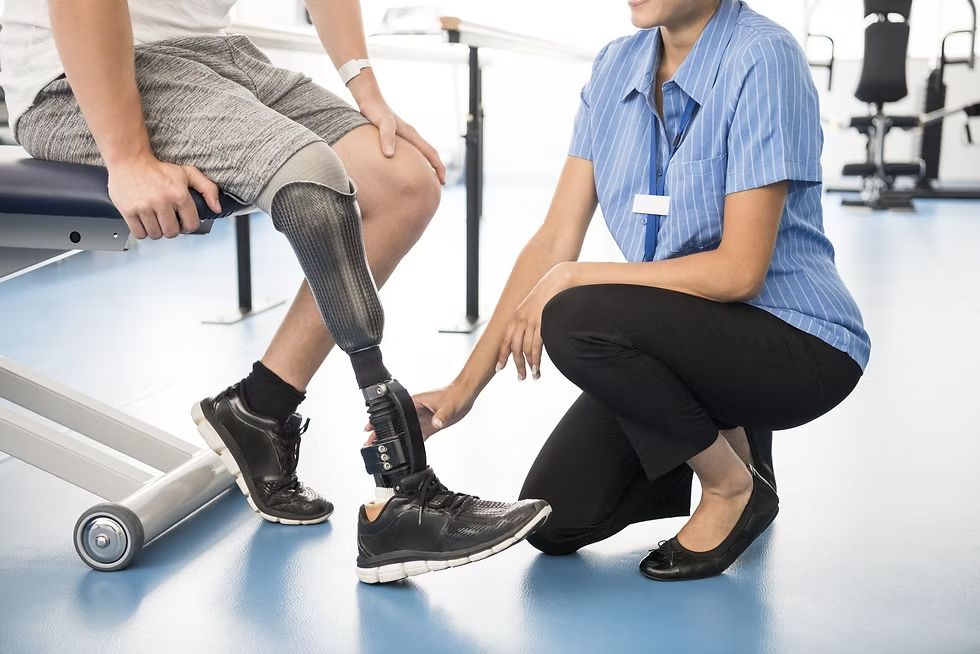
Targeted Muscle Reinnervation (TMR)
Plastic Surgery
Starting from
$12,000
Up to $35,000 depending on centre
Typical duration
5–14 days
Including pre-operative work-up

Content reviewed for medical accuracy by: Dr. Rodina Ainasoa · Medical Content Writer & Health Communications
Overview
Targeted muscle reinnervation is a microsurgical nerve-transfer procedure that reroutes cut peripheral nerves from an amputated limb into nearby residual muscle segments. Performed either at the time of amputation or afterward, it reduces neuroma and phantom limb pain and creates stronger, more intuitive control signals for advanced myoelectric and bionic prostheses. This is a surgical nerve procedure distinct from fitting the prosthetic device itself.
Your case is matched to a centre on the basis of clinical outcome data, not marketing. We coordinate every step — from pre-operative work-up to post-treatment follow-up — with a dedicated care coordinator.
What's included
Targeted Muscle Reinnervation (TMR)
Coordinated from
or message us on WhatsApp
No commitment required. Your data is never shared with third parties.
What TMR Is & Who's a Candidate
Targeted muscle reinnervation (TMR) reroutes cut peripheral nerves from an amputated limb into nearby residual muscle segments, closing the neuromuscular loop the nerve lost when the limb was removed. It is offered in two main scenarios.
New amputees (primary TMR)
Performed at the same time as the amputation itself, primary TMR is used preventively to reduce the chance of developing painful neuromas and chronic phantom limb pain before they set in.
Existing amputees (secondary/delayed TMR)
For patients already living with an amputation who have chronic phantom limb pain or a painful neuroma at the residual limb, or who want stronger control signals for an advanced myoelectric or bionic prosthesis, TMR can be performed months or years later as a dedicated procedure.
The Nerve-Transfer Procedure: Step by Step
TMR is peripheral-nerve microsurgery performed under an operating microscope, not a device-fitting appointment. The steps below outline the general surgical pathway; your plastic/hand surgeon will confirm specifics based on your amputation level and nerve anatomy.
Nerve mapping and surgical planning
The surgical team identifies the major cut nerves in the residual limb and maps nearby expendable motor nerve branches and muscle segments that can serve as new targets for each nerve.
Nerve dissection and preparation
Under microscope magnification, the transected nerve endings and the selected target motor nerve branches are carefully dissected free from surrounding tissue in preparation for transfer.
Microsurgical nerve transfer and coaptation
Each cut nerve is rerouted and surgically coapted (joined) to its new target motor nerve close to the muscle it will reinnervate, so the nerve has a productive pathway to grow into instead of forming a painful neuroma.
Closure and initial recovery
The surgical site is closed, and post-operative pain management and wound care begin while the transferred nerves start the slow process of regrowing into their new muscle targets.
Nerve Reinnervation & Recovery Timeline
Initial wound healing and post-operative pain management take place; some patients notice early changes in residual or phantom limb pain, though nerve regrowth is only just beginning.
Transferred nerves continue regrowing toward their new muscle targets. Twitching or flickering in the reinnervated muscle is common during this period as new connections form.
Reinnervation matures, and clinical trial data show phantom limb and residual limb pain scores continuing to improve through roughly the first year after surgery, alongside stronger, more distinguishable muscle signals.
Once reinnervation is established, patients who plan to use an advanced myoelectric or bionic prosthesis can proceed to prosthetist fitting and EMG signal-calibration sessions using the new, clearer control signals.
Source: Valerio et al., "Targeted Muscle Reinnervation Treats Neuroma and Phantom Pain in Major Limb Amputees: A Randomized Clinical Trial," Annals of Surgery (2019); peer-reviewed plastic/hand surgery literature (PubMed/PMC). Individual recovery and reinnervation timelines vary.
Known Risks & Limitations
- As with any surgery, there are risks of bleeding, infection, and anesthesia-related complications at the surgical site, and results depend on surgical technique and individual nerve anatomy.
- Pain relief and signal improvement develop gradually over months as the transferred nerves regrow into their new muscle targets — TMR is not an immediate fix, and some patients experience temporary new sensations during reinnervation.
- TMR does not guarantee complete elimination of phantom limb or neuroma pain for every patient; published trial data show significant average improvement, but individual outcomes vary and some residual symptoms can persist.
- TMR is a distinct surgical procedure from fitting a myoelectric or bionic prosthesis — patients pursuing an advanced device will still need a separate prosthetist evaluation, fitting, and calibration process after nerve recovery.
Source: Valerio et al., Annals of Surgery (2019) randomized clinical trial; peer-reviewed plastic/hand surgery and StatPearls literature. Individual risk factors vary and should be discussed with your treating surgeon.
Global cost comparison — Targeted Muscle Reinnervation (TMR)
Average coordinated costs across our partner centres. Final pricing depends on clinical complexity and chosen hospital.
| Country | Avg. cost | vs. cheapest |
|---|---|---|
🇮🇳 India New Delhi · Chennai · Bengaluru · Hyderabad · Mumbai · Kochi | $14,000 | —chevron_right |
🇹🇷 Turkey Istanbul | $22,000 | +57%chevron_right |
🇹🇭 Thailand Bangkok · Phuket · Chiang Mai | $18,000 | +29%chevron_right |
Costs are indicative estimates and vary by procedure specifics, hospital, and clinical complexity. Request a personalised estimate for your specific case.
Frequently asked questions
TMR is a surgical nerve procedure, not a device fitting. It reroutes the cut nerves that once controlled the amputated limb into nearby muscle segments, reducing phantom and neuroma pain and creating clearer electrical signals at the skin surface. A separate prosthetist visit is needed afterward to fit and calibrate a myoelectric or bionic prosthesis that reads those signals — TMR prepares the body for that device, it is not the device itself.
No fees. No commitment.
Our guidance is completely free
We are compensated by our partner hospitals — never by patients. You get independent clinical matching, cost transparency, and end-to-end coordination at no cost to you.