
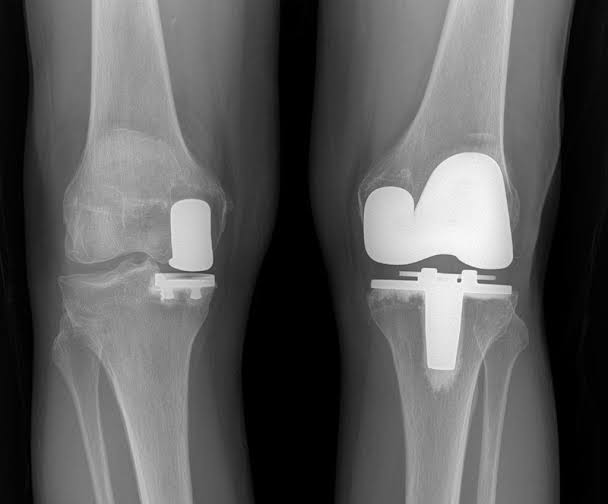
Robotic-Assisted Knee Replacement
Orthopedics
Starting from
$7,200
Up to $16,000 depending on centre
Typical duration
7–14 days
Including pre-operative work-up

Content reviewed for medical accuracy by: Dr. Rodina Ainasoa · Medical Content Writer & Health Communications
Overview
Robotic-arm-assisted total and partial knee arthroplasty for end-stage knee osteoarthritis — a robotic surgical system helps the surgeon plan and execute implant positioning with sub-millimetre precision, aiming for optimal alignment and a more consistent, personalised fit than freehand instrumentation alone.
Your case is matched to a centre on the basis of clinical outcome data, not marketing. We coordinate every step — from pre-operative work-up to post-treatment follow-up — with a dedicated care coordinator.
What's included
Robotic-Assisted Knee Replacement
Coordinated from
or message us on WhatsApp
No commitment required. Your data is never shared with third parties.
Robotic-Assisted vs. Conventional (Manual) Knee Replacement
Both approaches resurface the damaged knee joint with the same implant designs. The difference is how the surgeon plans and executes implant positioning — a robotic-arm system assists with 3D surgical planning and precise bone preparation, while conventional replacement relies on freehand mechanical instrumentation guided by the surgeon's experience.
| Parameter | Robotic-Assisted | Conventional (Manual) |
|---|---|---|
| Alignment accuracy | Studies report a lower mean mechanical-axis deviation (around 1.9°) and a higher proportion of patients meeting functional-alignment targets (around 90%), per peer-reviewed comparative studies. | Higher mean mechanical-axis deviation (around 2.8°) and a lower proportion of patients meeting functional-alignment targets (around 35%) in the same comparative studies. |
| Complication rates | No additional risk of postoperative complications compared with conventional technique, with fewer radiographic outliers and a lower reported risk of iatrogenic soft-tissue injury. | Established, long-track-record complication profile; soft-tissue injury risk is somewhat higher than reported for robotic assistance in comparative studies. |
| Surgeon learning curve | A learning curve of roughly seven cases has been reported for operative time and surgical-team workflow, but cumulative experience does not affect the accuracy of implant positioning even early on. | No robotic-specific learning curve; accuracy depends on the individual surgeon's freehand technique and experience. |
| Cost | Carries a cost premium reflecting robotic system usage and case-specific 3D planning, typically over and above the conventional price. | Lower baseline cost — no robotic system usage or planning fee. |
| Best suited for | Patients seeking the most precise implant alignment, complex deformity correction, or wanting to minimise revision risk from malalignment. | Patients with straightforward anatomy where a lower cost is the priority and experienced freehand technique is well established. |
Source: NCBI/PMC comparative and systematic-review studies of robotic-assisted vs. conventional total knee arthroplasty; American Academy of Orthopaedic Surgeons (AAOS). Individual outcomes depend on your surgeon's expertise and your own anatomy — this is a clinical decision made with your orthopaedic team, not a self-assessment.
Known Risks & Limitations
- As with any knee replacement, risks include infection, blood clots, implant loosening over time, and anaesthesia-related complications, regardless of technique used.
- Robotic assistance is a planning and execution aid for the surgeon, not a substitute for surgical judgement — outcomes still depend heavily on surgeon expertise and individual patient anatomy.
- Not every patient or every centre offers robotic-assisted knee replacement; availability depends on equipment access and surgeon training at the treating hospital.
Source: NCBI/PMC; American Academy of Orthopaedic Surgeons (AAOS). No procedure is without risk; your orthopaedic surgeon will review your individual risk factors and confirm whether robotic assistance is appropriate for your case.
Global cost comparison — Robotic-Assisted Knee Replacement
Average coordinated costs across our partner centres. Final pricing depends on clinical complexity and chosen hospital.
| Country | Avg. cost | vs. cheapest |
|---|---|---|
🇮🇳 India New Delhi · Chennai · Bengaluru · Hyderabad · Mumbai · Kochi | $7,600 | —chevron_right |
🇹🇷 Turkey Istanbul | $12,500 | +64%chevron_right |
🇹🇭 Thailand Bangkok · Phuket · Chiang Mai | $11,200 | +47%chevron_right |
Costs are indicative estimates and vary by procedure specifics, hospital, and clinical complexity. Request a personalised estimate for your specific case.
Frequently asked questions
Peer-reviewed studies report that robotic-assisted knee replacement improves the accuracy of implant positioning and limb alignment compared with conventional manual instrumentation, with a higher proportion of patients meeting target alignment criteria and fewer radiographic outliers. Robotic assistance is a planning and execution aid for the surgeon — outcomes still depend heavily on surgical expertise and individual patient anatomy.
No fees. No commitment.
Our guidance is completely free
We are compensated by our partner hospitals — never by patients. You get independent clinical matching, cost transparency, and end-to-end coordination at no cost to you.