
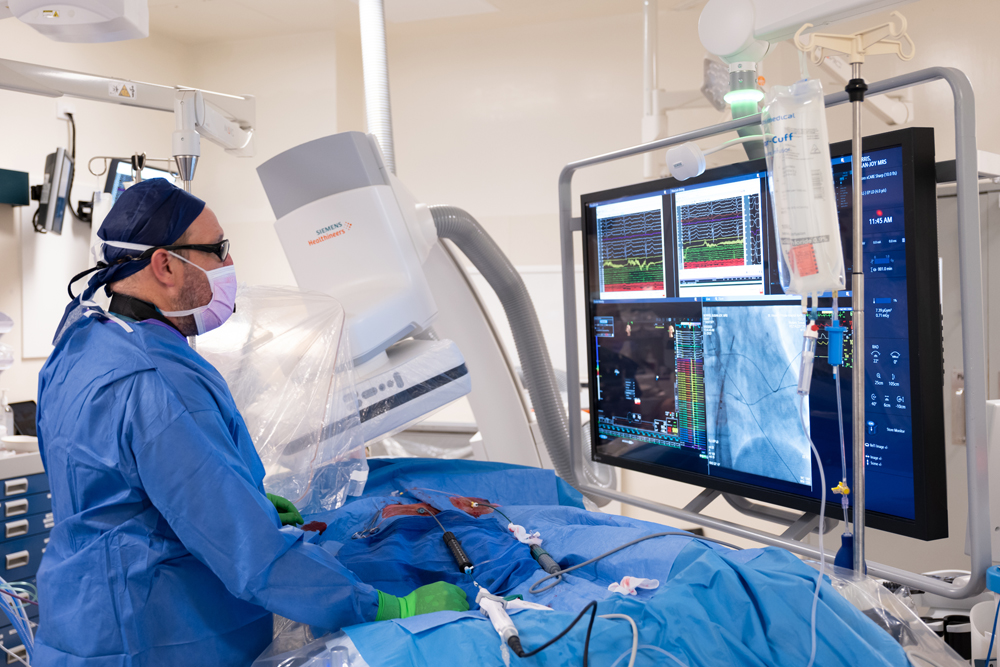
MitraClip / Transcatheter Edge-to-Edge Repair (TEER)
Cardiology
Starting from
$25,000
Up to $45,000 depending on centre
Typical duration
7–12 days
Including pre-operative work-up

Content reviewed for medical accuracy by: Dr. Rodina Ainasoa · Medical Content Writer & Health Communications
Overview
MitraClip (transcatheter edge-to-edge repair, or TEER) is a minimally invasive, catheter-based procedure that clips together the mitral valve leaflets to reduce severe mitral regurgitation, without open-heart surgery. It is aimed at patients with primary or secondary mitral regurgitation who are at high or prohibitive risk for conventional mitral valve surgery. JCI-accredited structural heart programs in India and Turkey offer TEER with 3D transesophageal echo guidance and experienced heart teams at a fraction of US or UK costs.
Your case is matched to a centre on the basis of clinical outcome data, not marketing. We coordinate every step — from pre-operative work-up to post-treatment follow-up — with a dedicated care coordinator.
What's included
MitraClip / Transcatheter Edge-to-Edge Repair (TEER)
Coordinated from
or message us on WhatsApp
No commitment required. Your data is never shared with third parties.
Who Is a Candidate for MitraClip / TEER?
MitraClip (transcatheter edge-to-edge repair, or TEER) is generally aimed at patients with severe mitral regurgitation who are at high or prohibitive risk for open mitral valve surgery. Candidacy is decided by a multidisciplinary Heart Team — not by patient self-assessment — based on echocardiography, valve anatomy, and overall surgical risk.
- Severe primary (degenerative) mitral regurgitation in patients whose surgical risk is elevated due to age, frailty, or other medical conditions.
- Severe secondary (functional) mitral regurgitation with heart failure, remaining symptomatic despite maximally tolerated guideline-directed medical therapy — the population studied in the COAPT and MITRA-FR trials.
- Suitable mitral valve leaflet anatomy on transesophageal echocardiography, confirmed before the procedure is scheduled.
- The COAPT and MITRA-FR trials reached different conclusions on secondary mitral regurgitation, underscoring that patient selection — not the device alone — determines benefit; this is why a Heart Team review is required rather than a fixed checklist.
Source: American College of Cardiology; COAPT and MITRA-FR trial publications. Candidacy is a clinical Heart Team decision, not a self-assessment.
The Procedure: Step by Step
MitraClip/TEER is a catheter-based procedure performed under general anaesthesia with continuous transesophageal echo guidance, typically taking a few hours.
Venous access
The interventional cardiologist accesses the femoral vein, usually through a small incision in the groin.
Transseptal crossing
A catheter is guided from the vein, across the wall separating the heart's right and left atria, into the left atrium above the mitral valve.
Clip deployment under echo guidance
Using real-time transesophageal echocardiography, the cardiologist positions the clip to grasp the mitral valve leaflets, reducing regurgitation. Clip position is checked and adjusted before final release, and more than one clip may be placed if needed.
Confirm function and close
The team confirms reduced mitral regurgitation and acceptable valve function by echo, then withdraws the catheters and closes the small venous access site.
Recovery Timeline
Most patients spend one to two days in a monitored cardiac unit immediately after the procedure.
Hospital discharge typically occurs within a few days, once echo confirms stable valve function and the access site has healed.
Most everyday activity is resumed within one to two weeks, since MitraClip avoids the chest incision and heart-lung bypass used in open mitral valve surgery.
A follow-up echocardiogram at around 30 days assesses durability of the repair and guides any medication adjustments.
Source: American College of Cardiology; Mayo Clinic. Individual recovery varies and is guided by your care team.
Known Risks & Limitations
- As with any catheter-based cardiac procedure, risks include bleeding or vascular injury at the access site, per NCBI/StatPearls.
- Residual or recurrent mitral regurgitation can occur, and a small proportion of patients require a repeat procedure or later surgery.
- Rare but recognised complications include clip detachment, mitral valve stenosis from over-tightening, and injury to the atrial septum at the crossing site.
- The COAPT and MITRA-FR trials showed diverging outcomes in secondary mitral regurgitation, illustrating that benefit depends heavily on appropriate patient selection by the Heart Team rather than the device alone.
- General anaesthesia and pre-existing heart failure carry their own procedural risks, which the Heart Team weighs against the risks of open surgery or continued medical therapy.
Source: American College of Cardiology; NCBI/StatPearls; COAPT and MITRA-FR trial publications. No procedure is without risk; a multidisciplinary Heart Team reviews your individual anatomy and risk profile before recommending MitraClip/TEER, surgical repair, or continued medical management — this is a clinical decision, not a self-assessment.
Global cost comparison — MitraClip / Transcatheter Edge-to-Edge Repair (TEER)
Average coordinated costs across our partner centres. Final pricing depends on clinical complexity and chosen hospital.
| Country | Avg. cost | vs. cheapest |
|---|---|---|
🇮🇳 India New Delhi · Chennai · Bengaluru · Hyderabad · Mumbai · Kochi | $26,000 | —chevron_right |
🇹🇷 Turkey Istanbul | $32,000 | +23%chevron_right |
Costs are indicative estimates and vary by procedure specifics, hospital, and clinical complexity. Request a personalised estimate for your specific case.
Frequently asked questions
Candidacy is decided by a multidisciplinary Heart Team, not a self-assessment. MitraClip/TEER is generally reserved for patients with severe mitral regurgitation who are at high or prohibitive surgical risk, based on trials such as COAPT (secondary MR) and MITRA-FR, whose results diverged based on patient selection. A cardiac CT and echocardiogram sent in advance let the overseas heart team assess valve anatomy and confirm suitability before you travel.
No fees. No commitment.
Our guidance is completely free
We are compensated by our partner hospitals — never by patients. You get independent clinical matching, cost transparency, and end-to-end coordination at no cost to you.